
What is the Circle of Fifths?
The Circle of Fifths is a diagram that places all 12 major keys around a circle, each one a perfect fifth above the key before it. Start at C at the top and move clockwise: C, G, D, A, E, B, F♯… Each step clockwise adds one sharp to the key signature. Move counter-clockwise from C instead — F, B♭, E♭, A♭ — and each step adds one flat.
The inner ring shows each key's relative minor: the minor key that shares the same key signature. A minor sits inside C major, E minor inside G major, and so on around the wheel.
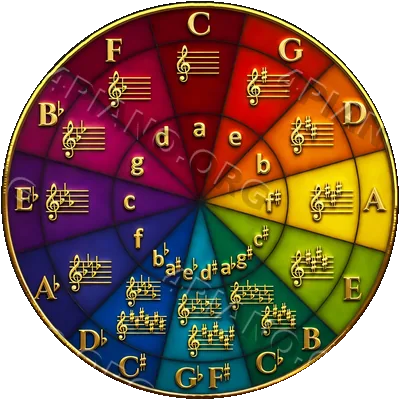
How to read the circle
- Find the key name on the outer ring. That's the major key.
- Count the steps from C. Clockwise steps = number of sharps. Counter-clockwise steps = number of flats.
- Look inward for the relative minor, which uses the same notes and the same key signature.
- Look left and right. The two neighbours of any key are its closest relatives — the keys a song most often moves to.
The order of sharps and flats
Sharps are always added in the same order: F♯ C♯ G♯ D♯ A♯ E♯ B♯. A common memory line is “Father Charles Goes Down And Ends Battle.” Flats come in the exact reverse order: B♭ E♭ A♭ D♭ G♭ C♭ F♭ — “Battle Ends And Down Goes Charles' Father.”
Two quick tricks: in a sharp key, the last sharp is one half step below the key's name (last sharp F♯ → key of G). In a flat key with two or more flats, the second-to-last flat is the key's name (B♭, E♭ → key of B♭).
All 12 keys at a glance
| Major key | Key signature | Relative minor | Scale notes |
|---|---|---|---|
| C major | none | A minor | C D E F G A B |
| G major | 1 sharp: F♯ | E minor | G A B C D E F♯ |
| D major | 2 sharps: F♯, C♯ | B minor | D E F♯ G A B C♯ |
| A major | 3 sharps: F♯, C♯, G♯ | F♯ minor | A B C♯ D E F♯ G♯ |
| E major | 4 sharps: F♯, C♯, G♯, D♯ | C♯ minor | E F♯ G♯ A B C♯ D♯ |
| B major | 5 sharps: F♯, C♯, G♯, D♯, A♯ | G♯ minor | B C♯ D♯ E F♯ G♯ A♯ |
| F♯ major | 6 sharps: F♯, C♯, G♯, D♯, A♯, E♯ | D♯ minor | F♯ G♯ A♯ B C♯ D♯ E♯ |
| D♭ major | 5 flats: B♭, E♭, A♭, D♭, G♭ | B♭ minor | D♭ E♭ F G♭ A♭ B♭ C |
| A♭ major | 4 flats: B♭, E♭, A♭, D♭ | F minor | A♭ B♭ C D♭ E♭ F G |
| E♭ major | 3 flats: B♭, E♭, A♭ | C minor | E♭ F G A♭ B♭ C D |
| B♭ major | 2 flats: B♭, E♭ | G minor | B♭ C D E♭ F G A |
| F major | 1 flat: B♭ | D minor | F G A B♭ C D E |
At the bottom of the circle, three keys can be written two ways. B major (5 sharps) sounds the same as C♭ major (7 flats); F♯ major (6 sharps) sounds the same as G♭ major (6 flats); D♭ major (5 flats) sounds the same as C♯ major (7 sharps). These are called enharmonic keys.
Why it matters for a young pianist
- Key signatures stop being a memory test. Once a child sees the pattern, the number of sharps or flats in any key can be worked out in seconds.
- Chords make sense. In any major key, the three main chords — I, IV and V — are the key itself and its two neighbours on the circle. In C major that's C, F and G.
- Scales get easier. Each new scale clockwise changes just one note from the scale before it.
- Songs get predictable. Music usually moves to nearby keys on the circle, so children start to hear where a piece is going.
A short history
The idea of stacking fifths goes back to Pythagoras and ancient Greek tuning. The circle as a diagram appeared in the late 1600s in the writing of Nikolay Diletsky, and Johann David Heinichen published a widely used version in 1728. Musicians have used it for three centuries since — from beginner theory books to jazz improvisation.